Welcome
The Problem
By the year 2050, nearly 80% of the earth's population will reside in urban
centers. Applying the most conservative estimates to current demographic trends,
the human population will increase by about 3 billion people during the interim.
An estimated 109 hectares of new land (about 20% more land than is
represented by the country of Brazil) will be needed to grow enough food to feed
them, if traditional farming practices continue as they are practiced today. At
present, throughout the world, over 80% of the land that is suitable for raising
crops is in use (sources: FAO and NASA). Historically, some 15% of that has been
laid waste by poor management practices. What can be done to avoid this
impending disaster?
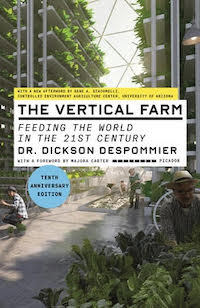
A Potential Solution: Farm Vertically
The concept of indoor farming is not new, since hothouse production of tomatoes,
a wide variety of herbs, and other produce has been in vogue for some time. What
is new is the urgent need to scale up this technology to accommodate another 3
billion people. An entirely new approach to indoor farming must be invented,
employing cutting edge technologies. The Vertical Farm must be efficient (cheap
to construct and safe to operate). Vertical farms, many stories high, will be
situated in the heart of the world's urban centers. If successfully implemented,
they offer the promise of urban renewal, sustainable production of a safe and
varied food supply (year-round crop production), and the eventual repair of
ecosystems that have been sacrificed for horizontal farming.
It took humans 10,000 years to learn how to grow most of the crops we now take
for granted. Along the way, we despoiled most of the land we worked, often
turning verdant, natural ecozones into semi-arid deserts. Within that same time
frame, we evolved into an urban species, in which 60% of the human population
now lives vertically in cities. This means that, for the majority, we humans are
protected against the elements, yet we subject our food-bearing plants to the
rigors of the great outdoors and can do no more than hope for a good weather
year. However, more often than not now, due to a rapidly changing climate
regime, that is not what follows. Massive floods, protracted droughts, class 4-5
hurricanes, and severe monsoons take their toll each year, destroying millions
of tons of valuable crops. Don't our harvestable plants deserve the same level
of comfort and protection that we now enjoy? The time is at hand for us to learn
how to safely grow our food inside environmentally controlled multistory
buildings within urban centers. If we do not, then in just another 50 years, the
next 3 billion people will surely go hungry, and the world will become a much
more unpleasant place in which to live.
Advantages of Vertical Farming
 |
Year-round crop production; 1 indoor acre is equivalent to 4-6 outdoor acres or
more, depending upon the crop (e.g., strawberries: 1 indoor acre = 30 outdoor
acres) |
 |
No weather-related crop failures due to droughts, floods, pests |
 |
All VF food is grown organically: no herbicides, pesticides, or fertilizers
|
 |
VF virtually eliminates agricultural runoff by recycling black water |
 |
VF returns farmland to nature, restoring ecosystem functions and services |
 |
VF greatly reduces the incidence of many infectious diseases that are acquired
at the agricultural interface |
 |
VF converts black and gray water into potable water by collecting the water of
evapotranspiration |
 |
VF adds energy back to the grid via methane generation from composting
non-edible
parts of plants and animals
|
 |
VF dramatically reduces fossil fuel use (no tractors, plows, shipping.) |
 |
VF converts abandoned urban properties into food production centers |
 |
VF creates sustainable environments for urban centers |
 |
VF creates new employment opportunities |
 |
We cannot go to the moon, Mars, or beyond without first learning to farm indoors
on
earth |
 |
VF may prove to be useful for integrating into refugee camps |
 |
VF offers the promise of measurable economic improvement for tropical and
subtropical
LDCs. If this should prove to be the case, then VF may be a catalyst in helping
to reduce or even reverse the population growth of LDCs as they adopt urban
agriculture as a strategy for sustainable food production.
|
 |
VF could reduce the incidence of armed conflict over natural resources, such as
water
and land for agriculture |

Copyright © 2008 The Vertical Farm Project. All Rights Reserved.